
Reliable Water, Better Harvests: Why Irrigation Research Matters
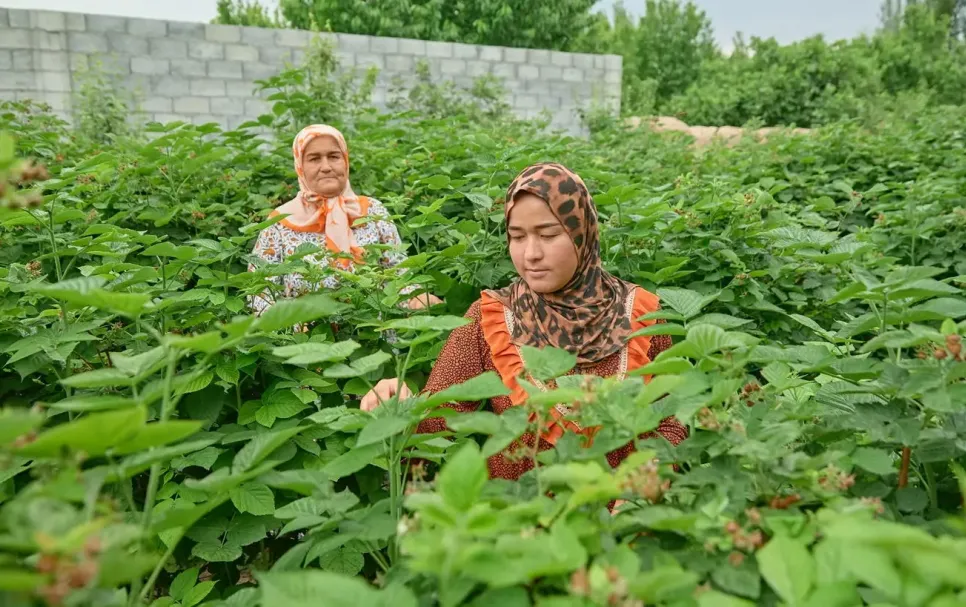
In Uzbekistan’s Ferghana Valley, the return of reliable irrigation has changed what some families can grow and earn from their land. Fields that had struggled because water could not reach them are producing again. In Usmonobod village, a family growing raspberries has moved from barely one harvest a year to two, with better-quality fruit now reaching the local market. Nearby, an orchard that had been dry is back in production.
Behind those changes is a much larger effort to repair an irrigation system that had become increasingly inefficient. The Ferghana Valley is home to about 10 million people and is one of Uzbekistan’s most important agricultural regions. Yet ageing infrastructure, water losses and the effects of climate change were putting growing pressure on farming. At the furthest points of the canal network, water supply could fall about 30 per cent below demand, particularly between April and June when crops needed it most. More than one billion cubic metres of water were being lost each year.
The second phase of the Ferghana Valley Water Resources Management Project has rehabilitated about 365 kilometres of canals, repaired nearly 1,500 water-control structures and drilled close to 500 irrigation wells. More than 100,000 hectares now have improved irrigation and drainage, benefiting almost 65,000 farmers. Better water delivery is saving an estimated 130 million cubic metres annually.
Those figures make the scale of the investment clear. What makes the story particularly important to agricultural research, however, is what happened after the infrastructure began working better. More reliable water changed crop production, land use, household income and the choices farmers could make about what to grow.
That is also where the experience becomes relevant to Uganda.
Uganda’s Fourth National Development Plan places increased access to water for agricultural production among its agro-industrialisation priorities. NDP IV calls for investments that include solar-powered irrigation, groundwater systems, gravity-flow irrigation, multipurpose water infrastructure and micro-irrigation for farmer groups. As the country expands these systems, the challenge is not simply to install more irrigation equipment. Decisions have to be based on evidence about where irrigation is most suitable, how much water is available, which crops make the best use of it and whether farmers can afford to operate the systems over time.
Agriculture, water resources, engineering and environmental management already meet within the University’s academic strengths. The Faculty of Agriculture and Animal Sciences specialises in crop production and management, agribusiness and agricultural extension, among other areas. The Faculty of Natural Resources and Environmental Sciences brings expertise in land resources, environmental planning, natural resource economics and environmental management, with academic work extending into fisheries and water resources management and climate change. Busitema’s Faculty of Engineering and Technology also covers irrigation, agricultural mechanisation, water resources engineering and agro-processing.
A crop scientist may establish that reliable irrigation improves a particular crop’s yield, but that finding becomes more useful when the amount of water required, the cost of delivering it and the effect on the water source are also understood. An engineer may design an efficient pumping system, but farmers still need to know whether the additional harvest will cover its energy and maintenance costs. Water-resource specialists may establish how much water a catchment can support, while agribusiness researchers examine whether the crops grown with that water have dependable and profitable markets.
Studied together, these factors provide a much stronger basis for deciding whether an irrigation investment is genuinely worthwhile.
The Ferghana project itself demonstrates why technical efficiency matters. Twelve irrigation wells were equipped with solar systems with a combined capacity of nearly 500 kilowatts. They now pump more than four million cubic metres of water each year while lowering operating costs and reducing carbon emissions.
Solar irrigation has particular relevance to Uganda because NDP IV specifically identifies solar-powered systems among the technologies intended to increase access to water for agricultural production. Yet the fact that solar pumping works in one setting does not automatically make every installation a good investment elsewhere. Local research is needed to understand the relationship between the size of a farm, the water source, crop choice, pumping requirements, initial costs and the farmer’s ability to maintain the equipment.
Eastern Uganda provides a useful setting for such work because the answers will vary across landscapes and farming systems. A solution that makes sense for a horticultural farmer may not be appropriate for a farmer growing a lower-value crop. Groundwater may be suitable in one location while surface water or water harvesting makes more sense elsewhere. The economics also change depending on the size of the farm, the reliability of the market and the value of the additional production.
Faculty of Natural Resources and Environmental Sciences becomes particularly important when these choices begin to affect the natural resource itself. Irrigation can reduce farmers’ exposure to unreliable rainfall, but poorly planned expansion can also increase pressure on rivers, wetlands and groundwater. Busitema’s research in natural resources, water management and climate change can help establish how much water is available, how demand is changing and how agricultural use can be balanced with other needs.
The Faculty of Engineering and Technology can address another part of the problem: getting water to the farm efficiently. Busitema’s Department of Water Resources Engineering covers irrigation, drainage, hydrology, hydraulic structures, flood control and environmental water management, giving researchers and students a strong technical base for examining how water is captured, moved and conserved.
The University already has evidence of interest in these questions. Research in its institutional repository includes work assessing irrigation potential using surface-water availability, while FNRES research has examined climate variability and its effects on crop production in Eastern Uganda. Building on such work could produce more detailed evidence about where irrigation is viable and how water systems should respond to changing climatic conditions.
The Uzbekistan experience also shows that infrastructure alone does not solve the problem. Almost 12,000 people were trained in efficient water use and improved agricultural practices alongside the investment in canals, wells and pumping systems. That matters because even a well-designed system can lose much of its value if water is poorly managed once it reaches the farm.
Busitema’s extension expertise can help close that gap. Working with farming communities would allow researchers to see whether recommended irrigation practices are practical, what prevents farmers from adopting them and how training can be improved. Students could take part in field studies measuring water use, crop performance, pumping costs and farmer experiences, turning irrigation schemes into places where learning and research respond to real agricultural problems.
The results would also have value beyond the University. MAAIF and the Ministry of Water and Environment are among the institutions responsible for NDP IV interventions aimed at expanding water for agricultural production, alongside other national and local actors. Evidence from universities can help such institutions judge which systems are suitable, where resources should be directed and how irrigation investments perform after installation.
Farmer organisations and private companies also have a stake in those findings. An irrigation technology may work technically but still fail to spread if the cost is beyond the reach of farmers, spare parts are difficult to find or maintenance requires skills that are unavailable locally. Research that considers those practical realities early can prevent promising technologies from ending as demonstrations that farmers cannot sustain.
This approach matches Busitema University’s published strategic framework, which prioritises high-impact research, innovation and entrepreneurship, identifies agriculture and environment among its research themes, and encourages a systems approach to research. It also promotes partnerships and undergraduate participation in research.
The Ferghana Valley does not provide Uganda with a blueprint. Its canals are being rebuilt within a different climate, economy and water system. What it does provide is evidence of how much can change when reliable water reaches farmland and when investment in infrastructure is supported by better management and farmer knowledge.
That is the more useful starting point for Busitema University. Irrigation research in Eastern Uganda can move beyond asking whether a pump, canal or solar system works. It can establish whether the water source can sustain it, whether the crop makes good use of the water, whether farmers earn enough to keep the system running and whether the surrounding environment can absorb the increased demand.
Reliable water can bring land back into production and give farmers greater control over what and when they grow. The research challenge is to make sure those gains are not temporary.
As Uganda expands access to irrigation under NDP IV, success will depend not only on the number of systems installed, but on whether they continue delivering water, better harvests and worthwhile returns without exhausting the resources on which future farming depends.
Source: This article was developed from the World Bank feature, Irrigation Investment Revives Farms in Uzbekistan’s Ferghana Valley
- 95 views