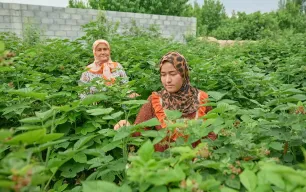
AgriConnect’s First Year Offers a Wider View of What Farmers Need to Succeed

One year after AgriConnect was launched, its work across Africa is beginning to show that improving agriculture takes more than helping farmers produce more. Roads, storage, finance, reliable markets, extension services, technology and sound policies all influence whether a good harvest eventually improves a household’s income.
The World Bank Group and the International Fund for Agricultural Development launched AgriConnect with other development and private sector partners to connect 300 million family and smallholder farmers worldwide to markets, finance and agricultural services by 2030. Half of the first ten AgriConnect country compacts have been launched in Africa, and the two institutions say their targeted investments have already reached at least 10 million farmers on the continent.
A year of implementation has also brought a clearer understanding of where agricultural progress can stall. Africa still faces major gaps in irrigation, energy, finance and digital services, and the World Bank estimates that closing the continent’s agricultural investment gap will require about US$180 billion. AgriConnect is responding by looking at the wider system surrounding the farmer rather than treating production as an isolated activity.
Angola provides one example of how this approach can work. The 1,300-kilometre Lobito Corridor links the mineral-producing areas of the Democratic Republic of Congo and Zambia to Angola’s Atlantic coast, but it also passes through major farming areas. AgriConnect is examining how farmers and cooperatives along the route can use the corridor to reach storage facilities, processors and wider markets more easily.
The broader lesson is that infrastructure can do more than move goods or provide services. When roads, transport networks, energy systems and other investments are planned with farmers and agribusinesses in mind, they can strengthen market access, lower costs and create opportunities across the agricultural value chain.
The Angola example also has relevance in Eastern Uganda, where higher production does not always translate into better returns. Research at Busitema University’s Faculty of Agriculture and Animal Sciences can help explain what happens between the farm and the market, including how storage, processing, pricing and access to buyers affect the value farmers ultimately receive from their crops and livestock products.
An improved variety or farming practice may increase production, but the benefit to farmers will also depend on whether the additional output can be stored safely, whether buyers are available, whether processing adds value and whether farmers can sell at a time that gives them a fair return. Research of this kind can complement work on crop and animal production with a stronger understanding of agribusiness, markets and extension.
Access to finance is another challenge AgriConnect is trying to address. In Togo, the initiative is seeking to mobilise more than US$100 million in private capital and increase agriculture’s share of bank lending from about 1.2 per cent to 5 per cent. Digital farmer registries, agricultural insurance, warehouse financing and credit guarantees are among the measures being used to make agricultural lending more workable.
Uganda’s circumstances are different, but the underlying difficulty is familiar. Farmers and agricultural enterprises often depend on seasonal income and operate in a sector exposed to weather, price changes and other risks that conventional lending may not accommodate well. Agribusiness research at Busitema can help establish where financing difficulties arise and which approaches are better suited to different categories of farmers and rural enterprises. Evidence on cooperatives, insurance, agricultural credit and other financing arrangements could inform decisions by farmers, banks, government agencies and organisations investing in agricultural value chains.
AgriConnect’s first year has also drawn attention to who is actually reached when agricultural services expand. The initiative stresses the importance of improving access to infrastructure, finance, markets and services for small-scale farmers, women and young rural entrepreneurs. In Ethiopia’s lowlands, a programme cited by the World Bank helped 825,000 pastoralists receive training and advisory support, while 2.7 million people gained broader access to markets and social services.
The experience highlights the difference between reaching farmers and improving their circumstances. A training programme may attract many participants, but its value becomes clearer when farmers are able to apply what they learned, afford the recommended technologies and see improvements in production or income. Research that follows these outcomes can help extension providers, local governments and development organisations understand where support is working and where farmers are still being left behind.
Academic staff and students at Busitema can contribute to that evidence through fieldwork in farming communities across Eastern Uganda. Such research can strengthen community engagement while giving students experience with problems that cut across agriculture, business, technology and public policy. Busitema’s published strategic framework already places emphasis on high-impact research, innovation and entrepreneurship, stronger partnerships and greater involvement of students in research. Agriculture and environment are also identified among the University’s research themes.
Environmental conditions are equally important. Agricultural growth depends on land, water and ecosystems that can come under greater pressure as production expands. The Faculty of Natural Resources and Environmental Sciences brings expertise in water resources, environmental planning, natural resource economics and climate change, helping to establish whether agricultural gains can be sustained over time.
An irrigation investment, for instance, may increase production but still depend on the amount and reliability of available water. Changes in land use can create new economic opportunities while placing pressure on wetlands or other ecosystems. Climate variability can also affect the suitability of crops, livestock systems and agricultural investments. Combining agricultural and environmental research can give farmers and decision-makers a fuller picture of the benefits and risks involved.
AgriConnect’s approach also leaves room for expertise beyond FAAS and FNRES. Its wider model includes digital and agricultural technologies, infrastructure, finance, farmer organisations, research, skills and policy reform. Engineers can contribute to irrigation, energy, processing and storage solutions. Computing researchers can work on agricultural data, digital advisory services and tools that connect farmers to information or markets. Economists and other social science researchers can examine markets, institutions and rural enterprises.
Uganda’s Fourth National Development Plan makes this kind of interdisciplinary work especially relevant. NDP IV seeks to raise household incomes and employment through sustainable industrialisation, while its agro-industrialisation priorities include higher agricultural production and productivity, better harvest and post-harvest handling, stronger value-addition infrastructure, improved market access, and greater access to agricultural finance and insurance.
The Plan also identifies skills gaps across the agro-industrialisation value chain, including agricultural extension, engineering, risk management and finance, agronomy and livestock nutrition. Busitema University is among the institutions contributing graduates to Uganda’s agricultural workforce, giving the University a role that extends beyond producing research. Teaching, student research and community engagement can all contribute to the knowledge and skills needed to move agriculture further into value addition and commercial production.
Partnerships will also matter if research is to influence what happens beyond the University. MAAIF, NARO, district local governments, farmer organisations, financial institutions, processors, technology companies and development organisations each work with different parts of the agricultural system. Collaboration with these actors can help Busitema researchers identify practical problems, test possible solutions and ensure useful findings reach the people making decisions.
AgriConnect’s first year does not provide a ready-made formula for Eastern Uganda. Angola’s transport infrastructure, Togo’s financing arrangements and Ethiopia’s work with pastoral communities were shaped by their own circumstances. Their value lies in the questions they raise about what farmers need beyond production.
Eastern Uganda needs its own evidence. Research can show where farmers lose value after harvest, why finance and markets remain difficult to reach, which technologies work under local conditions, and how production can grow without weakening the land and water resources on which farming depends.
Answering those questions would give Busitema University’s researchers something more valuable than a model borrowed from elsewhere: evidence that farmers, government agencies, businesses and development partners can use to make better decisions.
If AgriConnect’s first year has shown anything, it is that producing more is only part of the journey. The harder task is making sure that what farmers produce leads to better incomes, stronger rural enterprises and livelihoods that can last.
- 59 views