From Plastic Waste to Pavement: Busitema’s Plasphalt Moves Onto Ugandan Roads
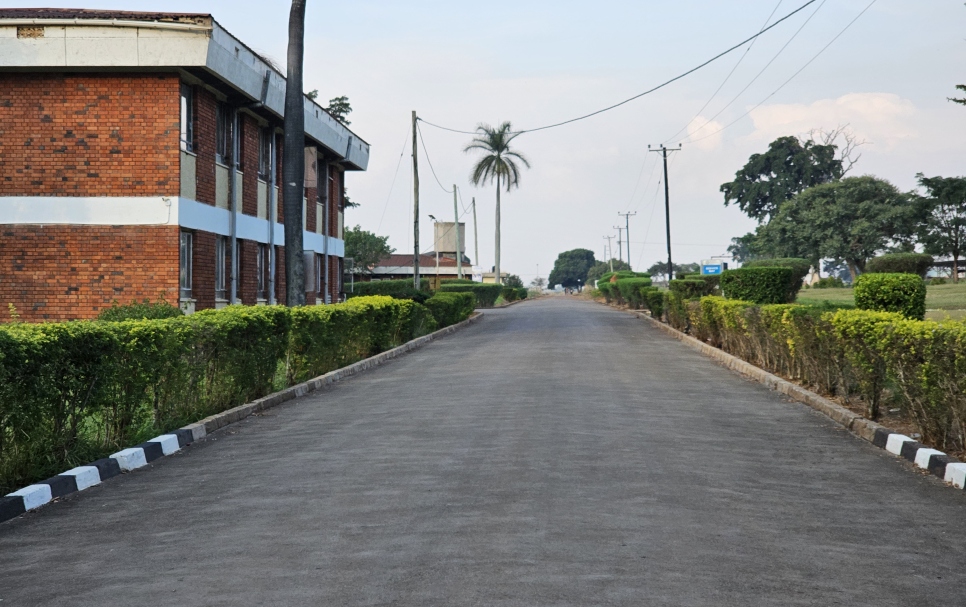
An idea that began with mixing discarded plastic into bitumen is starting to find its way onto Ugandan roads.
Busitema University reports that its SIMPLAB Plasphalt technology, which uses recycled plastic waste to improve asphalt, was first constructed at the University and is being rolled out on Nabwojjo Road in Namugongo B Division, Kira Municipality. The development takes earlier laboratory research a step closer to practical use.
The research behind the technology was carried out by Ashaba Osbert, Samson Rwahwire and Yvonne Tusiimire, who investigated whether polyethylene terephthalate, commonly known as PET and widely used in plastic drink bottles, could improve the properties of bitumen used in road construction.
Their study tested different amounts of waste PET, ranging from 2 to 12 per cent, together with 0.2 per cent lignin, a natural polymer used as a crosslinking agent.
One combination stood out. Adding 10 per cent waste PET and 0.2 per cent lignin increased the bitumen’s softening point from 46°C to 55°C and changed its penetration value from 85 to 46, indicating a harder material with improved resistance to softening.
That matters for road surfaces exposed to heat and repeated traffic loads. The researchers concluded that incorporating PET waste and lignin produced better properties than the unmodified bitumen used for comparison.
The idea has since developed into SIMPLAB Plasphalt, led by Assoc. Prof. Samson Rwahwire, who heads Busitema University’s Materials and Nanotechnology Center. The University describes the innovation as a waste-to-value technology aimed at improving road durability, strength and resilience while reducing plastic pollution.
Its rollout on Nabwojjo Road gives researchers and engineers an opportunity to observe how the material performs outside controlled laboratory conditions, where road surfaces must contend with traffic, changing temperatures and rainfall.
The technology also connects two challenges that are usually treated separately. Plastic waste requires collection and disposal, while road construction depends on large quantities of durable materials. Plasphalt explores whether part of one problem can become part of the solution to the other.
If the technology continues to perform well in practical use, its impact could extend beyond road engineering. Greater use of recycled plastic in construction could create demand for collection, sorting and processing, giving discarded plastic an economic value before it reaches drains, dumping sites and other parts of the environment.
The transition from a laboratory study published in 2022 to a technology now being applied on a Ugandan road is significant for Busitema University. It shows how materials research can move from testing an idea to developing something that can be evaluated under real conditions.
The original study, “Re-Engineering Plastic Waste for the Modification of Bitumen Blends,” was published in Advances in Science and Technology by Ashaba Osbert, Samson Rwahwire and Yvonne Tusiimire in August 2022.
- 99 views