Busitema University and NARO Harness Digital Technologies to Strengthen Climate-Smart Agriculture
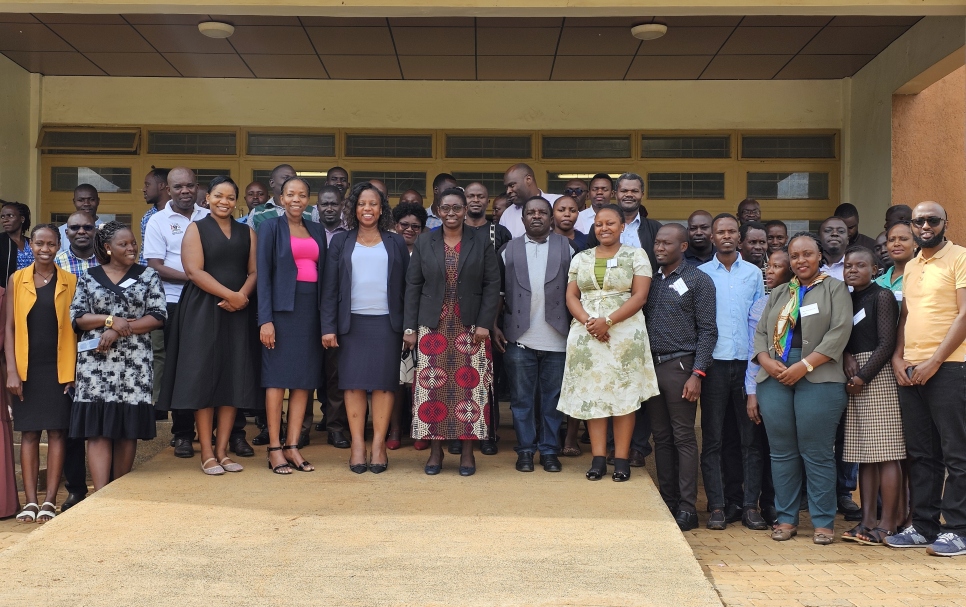
Busitema University, in collaboration with the National Agricultural Research Organisation (NARO), has undertaken a specialised training programme to equip agricultural scientists, researchers, technicians and extension workers with practical skills in climate data science, climate modelling and digital technologies. The initiative aims to strengthen the use of scientific information in addressing climate-related challenges affecting Uganda's agricultural sector.
The ten-day training, which commenced on 12 October 2026 at Busitema University's Main Campus, was conducted under the Uganda Climate-Smart Agricultural Transformation Project (UCSATP), implemented by the Ministry of Agriculture, Animal Industry and Fisheries (MAAIF) with support from the World Bank. NARO is among the project's implementing agencies, while Busitema University was responsible for preparing and delivering the technical training, providing facilities and guiding participants through practical exercises.
The programme comes against a background of increasingly unpredictable rainfall, drought and other climate-related challenges affecting agricultural production. It seeks to strengthen the ability of agricultural professionals to collect, analyse and interpret climate information and translate their findings into practical guidance for researchers, extension workers and farmers.
Speaking during the opening ceremony, Assoc. Prof. Saphina Biira, Deputy Vice-Chancellor for Academic Affairs and Research at Busitema University, welcomed the participants and expressed appreciation for the opportunity to host the training. She highlighted the University's academic environment and its seven-campus structure, which supports teaching, research and professional development across different disciplines.
Assoc. Prof. Biira encouraged participants to make good use of the University's facilities and the expertise of the facilitators. She also emphasised the importance of sharing the knowledge and experiences gained during the programme with colleagues in their respective institutions, so that its benefits extend beyond those attending.
Representing NARO's Director General, Dr. Winnie Nkalubo, Director of Research at the National Fisheries Resources Research Institute (NaFIRRI), thanked Busitema University for hosting the programme and described the training as an important step towards strengthening multidisciplinary agricultural research.
Dr. Nkalubo acknowledged the World Bank's financial support through UCSATP, noting its contribution to building capacity in climate data science and modelling. She highlighted unpredictable rainfall patterns, climate variability and emerging pests and diseases as some of the challenges affecting agricultural production and productivity in Uganda.
She emphasised that investing in the technical skills of agricultural researchers was also an investment in the future of farmers and families whose livelihoods depend on agriculture. She further underscored the importance of partnerships between NARO, universities and other research institutions in improving research methods, exchanging expertise and developing practical responses to agricultural challenges.
According to the organisers, the training was developed in response to gaps in the effective use of climate and agricultural data. Although meteorological records, satellite observations and agricultural datasets provide valuable information, their application requires specialised skills in data management, statistical analysis, geospatial mapping, modelling and the communication of research findings.
The programme covered three interconnected areas: environmental risks and agrometeorology, geospatial infrastructure and mapping, and bio-digital simulation and machine learning. These areas were selected to help participants move from collecting and interpreting data to developing tools that can inform agricultural planning and climate adaptation.
Participants were introduced to climate data acquisition, statistical analysis, rainfall and temperature trends, drought monitoring and agricultural early warning systems. The sessions examined how satellite imagery and rainfall information can be used to identify vegetation changes, monitor drought conditions and assess climate risks that may affect crop production.
Practical activities also focused on Global Positioning Systems (GPS), Geographic Information Systems (GIS) and remote sensing. Using tools such as Google Earth Pro and ArcGIS, participants were guided through collecting field coordinates, mapping farm boundaries, analysing terrain and developing irrigation layouts. These applications can help researchers assess agricultural landscapes and examine how land characteristics and water availability influence farming decisions.
Artificial intelligence and machine learning formed another component of the training. Participants were introduced to Python, Google Colab and Scikit-Learn for analysing agricultural datasets, examining climate trends and developing predictive models. The programme also covered climate projections and crop simulation using DSSAT and AquaCrop, tools that allow researchers to investigate how crops respond to different weather, soil and water-management conditions.
The training placed particular emphasis on practical assessment rather than attendance alone. Participants were expected to demonstrate their competencies through three technical outputs: an early-warning dashboard accompanied by a farmer advisory sheet, a geospatial mapping package incorporating an irrigation layout, and documented computational work involving machine learning and crop simulation.
The programme also provided for online technical presentations, portfolio reviews and assessments before a joint NARO–Busitema University expert panel. These sessions were designed to evaluate participants' ability to process data accurately, explain their findings, assess the reliability of their models and demonstrate how the results could support agricultural decisions.
The organisers explained that the knowledge gained would have different applications across agricultural research and extension services. Scientists and researchers could use the skills to investigate climate trends and evaluate adaptation strategies, while technicians could improve the management of environmental and spatial datasets. Extension workers, who connect research institutions with farming communities, could also use climate-risk information to provide farmers with more timely and relevant agricultural advice.
The organisers also identified opportunities for future cooperation between Busitema University and NARO in climate-smart agricultural research, data sharing, predictive modelling and staff training. Other proposed areas include developing digital tools to support agricultural research and extension services.
- 2 views