
Rukungiri Lithium Points Busitema Researchers Toward High-Power Energy Storage
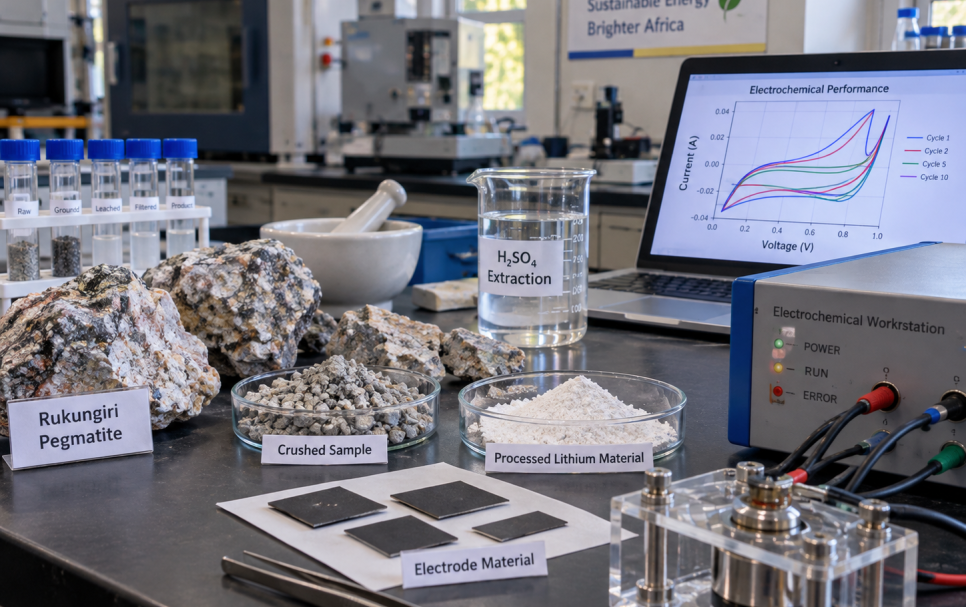
The lithium-bearing material extracted from rocks in Rukungiri did not perform strongly enough for the conventional lithium-ion batteries commonly associated with electric vehicles and electronics. Instead, laboratory tests pointed to a different possibility: energy-storage systems designed to deliver power quickly.
That unexpected result emerged from research by Ivan Ssebagala, Moses Kigozi and Samson Rwahwire, who investigated pegmatite rocks from Nyabushenyi in Rukungiri District to understand both their lithium content and the possible energy-storage applications of material recovered from them.
The researchers found only trace quantities of lithium in the original rocks. Using a sulfuric acid extraction process, however, they achieved about 53 per cent lithium recovery, producing material that could then be tested for its electrochemical properties.
The tests revealed relatively low energy density, which limits the material's suitability for conventional lithium-ion batteries where storing large amounts of energy is critical. Its power density was much stronger, reaching about 50 watts per gram.
That combination led the researchers towards hybrid capacitors and electric double-layer capacitors instead. Unlike conventional batteries, these systems are valued for their ability to charge and release energy rapidly, making them useful where short bursts of high power are more important than storing energy for long periods.
The finding changes the way the Rukungiri material can be viewed. The next step is understanding where the lithium found in these rocks could be most useful.
Ssebagala, Kigozi and Rwahwire also found that the Nyabushenyi pegmatite contained spodumene together with quartz and feldspar. Its physical properties make the material suitable for crushing and further processing, an important step in concentrating lithium before extraction.
There is still considerable distance between these laboratory findings and any future industrial application. The lithium concentration in the original samples was low, and the researchers recommend more advanced beneficiation and extraction techniques to improve both the amount recovered and its grade.
Environmental management would also have to form part of any further development. The study identifies the need for sustainable ways of handling waste generated during lithium processing, particularly if future research attempts to increase extraction at larger scales.
Those limitations do not diminish the importance of the work. Instead, they help define where research needs to go next.
The lithium-bearing material extracted from rocks in Rukungiri did not perform strongly enough for the conventional lithium-ion batteries commonly associated with electric vehicles and electronics. Instead, laboratory tests pointed to a different possibility: energy-storage systems designed to deliver power quickly.
That unexpected result emerged from research by Ivan Ssebagala, Moses Kigozi and Samson Rwahwire, who investigated pegmatite rocks from Nyabushenyi in Rukungiri District to understand both their lithium content and the possible energy-storage applications of material recovered from them.
The researchers found only trace quantities of lithium in the original rocks. Using a sulfuric acid extraction process, however, they achieved about 53 per cent lithium recovery, producing material that could then be tested for its electrochemical properties.
The tests revealed relatively low energy density, which limits the material's suitability for conventional lithium-ion batteries where storing large amounts of energy is critical. Its power density was much stronger, reaching about 50 watts per gram.
That combination led the researchers towards hybrid capacitors and electric double-layer capacitors instead. Unlike conventional batteries, these systems are valued for their ability to charge and release energy rapidly, making them useful where short bursts of high power are more important than storing energy for long periods.
Ssebagala, Kigozi and Rwahwire also found that the Nyabushenyi pegmatite contained spodumene together with quartz and feldspar. Its physical properties make the material suitable for crushing and further processing, an important step in concentrating lithium before extraction.
There is still considerable distance between these laboratory findings and any future industrial application. The lithium concentration in the original samples was low, and the researchers recommend more advanced beneficiation and extraction techniques to improve both the amount recovered and its grade.
Environmental management would also have to form part of any further development. The study identifies the need for sustainable ways of handling waste generated during lithium processing, particularly if future research attempts to increase extraction at larger scales.
Those limitations do not diminish the importance of the work. Instead, they help define where research needs to go next.
Uganda's mineral potential is often discussed in terms of what lies underground. This study moves the conversation a step further by examining what can actually be done with a locally available mineral after it is recovered.
Building that knowledge locally could strengthen research in mineral processing, materials engineering and energy storage while supporting wider efforts to add value to Uganda's natural resources before they leave the country.
The work by Ivan Ssebagala, Moses Kigozi and Samson Rwahwire therefore offers a more realistic picture of Rukungiri's lithium potential. The material may not be ready for use in locally made lithium-ion batteries, but the way it performs in high-power storage systems gives researchers another promising direction to explore.
The study, “Studying the energy storage potential of lithium materials extracted from Rukungiri pegmatites by sulfuric acid method,” was published in Next Materials in 2025.
- 152 views