Guild President Kamara Onesmus Outlines His Vision for a More Responsive and Inclusive Busitema University
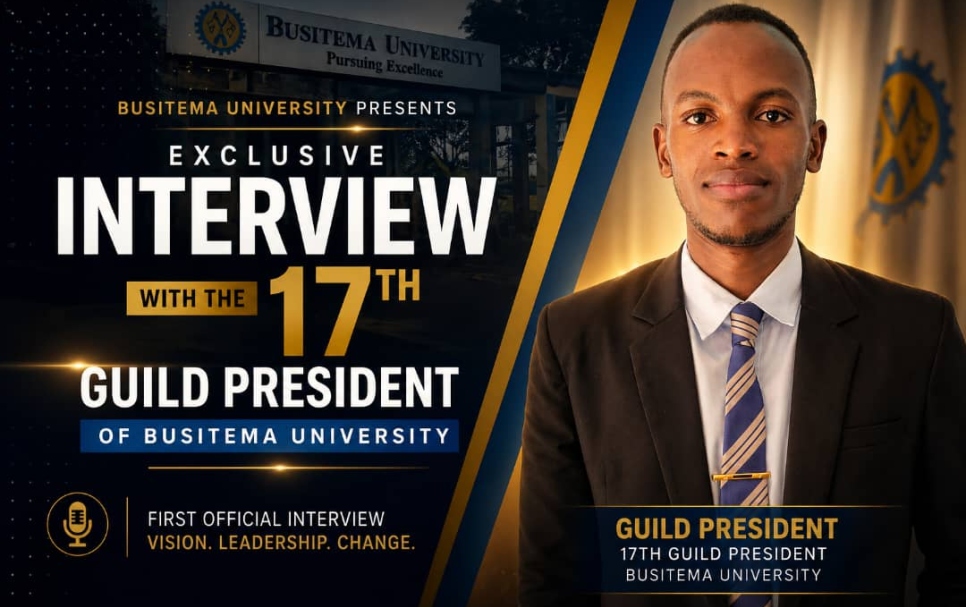
Guild President Kamara Onesmus Outlines His Vision for a More Responsive and Inclusive Busitema University
Busitema University’s newly elected Guild President, Kamara Onesmus, has begun his term with a clear focus on student welfare, accountability and practical reforms that reflect the needs of the entire student community. Kamara, a third‑year Water Resources Engineering student at the Faculty of Engineering and Technology, was elected as the seventeenth Guild President after a second attempt at the position. His return to the race, he says, was driven by the feedback he received from students and a renewed commitment to serve.
Students who supported him noted that his decision to run again demonstrated resilience and a willingness to listen. Kamara explains that this trust, rather than sympathy, formed the foundation of his successful campaign.
The recent shift to a fully online electoral process presented challenges for candidates, particularly the inability to hold open‑air campaigns or public debates. To reach students effectively, Kamara and his team adopted a door‑to‑door approach, visiting hostels and engaging students directly. He believes that while online voting should remain, the university should consider reinstating open‑air campaigns to give candidates an opportunity to present and defend their ideas in a public setting.
One of the first initiatives his government plans to implement is the Green Climate Initiative. The proposal includes a plastic bottle recycling programme across all campuses and efforts to establish functional green ecosystems at each site. Kamara also hopes to strengthen environmental collaboration between campuses such as Nagongera through structured exchange activities.
Tuition policy remains one of the most pressing concerns for students, and Kamara has placed it at the top of his agenda. He acknowledges that the current 60 percent payment threshold was introduced with good intentions but has had unintended consequences for students facing financial hardship. Under the existing system, students who fail to meet the threshold miss examinations and often lose an entire semester, with previously paid fees not carried forward.
Kamara is advocating for a more flexible approach. He proposes that examination access be linked to the number of course units a student has paid for, allowing them to sit the units covered by their payments. He also supports an alternative model where all students are allowed to sit examinations, with results withheld until outstanding balances are cleared. He believes this approach would protect academic progress while still upholding financial accountability.
During his campaign, Kamara pledged to work toward improved healthcare facilities at campuses such as Nagongera and Arapai. He maintains this commitment but acknowledges that achieving it within his eight‑month term will be challenging. The process requires consultations with the University Doctor, the Vice Chancellor and senior management. He intends to begin these discussions promptly and pursue the goal as far as institutional processes allow.
Kamara has also committed to strengthening accountability within the Guild leadership. Unlike previous Guild governments, which typically held one general assembly at the end of their term, his administration plans to hold two. The first will take place at the midpoint of the term to allow students to raise concerns while there is still time to address them. The second will be held at the end of the term to review progress and report on completed work.
As a member of the University Council, Kamara will represent student interests in key decision‑making spaces. He emphasises the importance of open communication between students and management. When disagreements arise, he expects constructive dialogue and clear explanations so that students understand the reasoning behind institutional decisions.
Kamara describes his leadership style as proactive and collaborative. He believes in delegating responsibilities but remains closely involved to ensure progress. He expects the same level of commitment from his team.
When asked what success would look like at the end of his term, Kamara says it would be reflected in the experience of an individual student who brought a concern to the Guild and saw a meaningful response. He hopes students will feel that their voices were heard and that the Guild worked actively on their behalf.
He concludes with a message to the student body, encouraging them to remain hopeful and engaged. He pledges to advocate, negotiate and serve diligently throughout his term.
- 68 views