Busitema University Scholar Co-Authors New Framework for Strengthening Integrity in Bibliometric Research
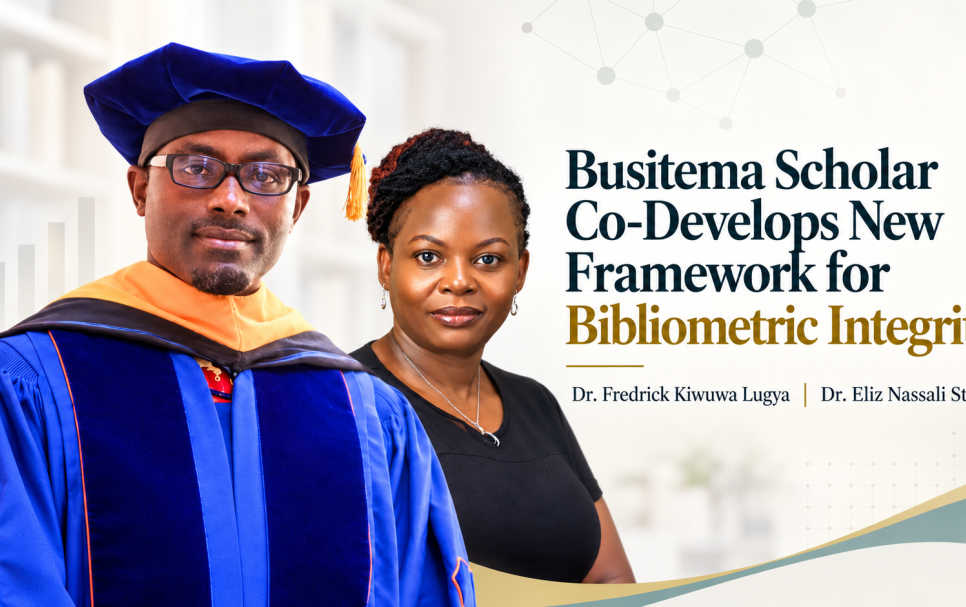
Busitema University Scholar Co-Authors New Framework for Strengthening Integrity in Bibliometric Research
How accurately can publication and citation figures tell the story of research, particularly in African scholarly environments where access, visibility and publishing infrastructure differ considerably?
A new study co-authored by Dr. Fredrick Kiwuwa Lugya, University Librarian at Busitema University, and Dr. Eliz Nassali State, University Librarian at Kyambogo University, proposes a framework for making bibliometric analysis more context-sensitive, transparent and academically rigorous.
The study, titled “A contextual framework for bibliometric integrity: synthesizing positivist and rationalist paradigms in the analysis of African LIS research during COVID-19,” is published in Global Knowledge, Memory and Communication, an Emerald Publishing journal.
Bibliometrics uses quantitative information such as publication output, citations and research visibility to examine patterns in scholarly communication. While these indicators can reveal important trends, Lugya and State argue that numbers should not be interpreted in isolation from the environments in which research is produced and disseminated.
Their study identifies several weaknesses that can affect bibliometric research, including oversimplifying changes across time, overlooking the context surrounding scholarly production, relying too heavily on a single source of data, and depending mainly on descriptive statistics.
To address these limitations, the researchers introduce a framework that brings together positivist and rationalist approaches to bibliometric inquiry. Rather than treating publication and citation data as sufficient explanations on their own, the framework encourages researchers to combine quantitative evidence with critical interpretation of the conditions that shape scholarly activity.
The study applies this thinking to Library and Information Science research in Africa during the COVID-19 period. Using a multi-phase mixed-methods approach, the researchers draw on a literature review, critical examination of earlier bibliometric work and an illustrative case study. Evidence is triangulated across sources including Scopus, Google Scholar, journal metadata and author surveys.
One of the study's notable findings challenges the assumption that changes in African Library and Information Science publication output during the period can be attributed mainly to the COVID-19 pandemic. The analysis suggests that publishing infrastructure already in place before the pandemic played a more important role in shaping research output. It also found significant differences in how research and citations were visible across different scholarly databases.
These findings underline a wider concern in research assessment. The same body of scholarship may appear differently depending on the database, indicators and analytical methods used. Without attention to such differences, bibliometric conclusions can misrepresent research activity, particularly in regions and disciplines that may already have lower representation in major international databases.
The proposed framework therefore calls for greater use of mixed methods, triangulation of data sources and consideration of local scholarly infrastructure when researchers assess publication productivity, research influence and citation patterns.
The authors argue that such an approach can contribute to more credible and equitable research assessment, particularly in underrepresented research environments. It also places academic integrity at the centre of bibliometric practice by asking researchers not only to calculate indicators, but also to explain what those indicators can reasonably tell us.
The framework adds to wider scholarly conversations on research integrity, responsible research assessment and the visibility of African scholarship, while showing how Library and Information Science research can help interrogate the ways academic knowledge is measured, interpreted and valued.
Readers can access the published article, “A contextual framework for bibliometric integrity: synthesizing positivist and rationalist paradigms in the analysis of African LIS research during COVID-19,” through Emerald Publishing. and
Busitema Digital Environment for Access to Research and Scholarship (BDEARS): https://bdears.busitema.ac.ug/handle/123456789/9451
- 825 views