Busitema University Librarian Co-Authors New Model for Understanding How People Really Search
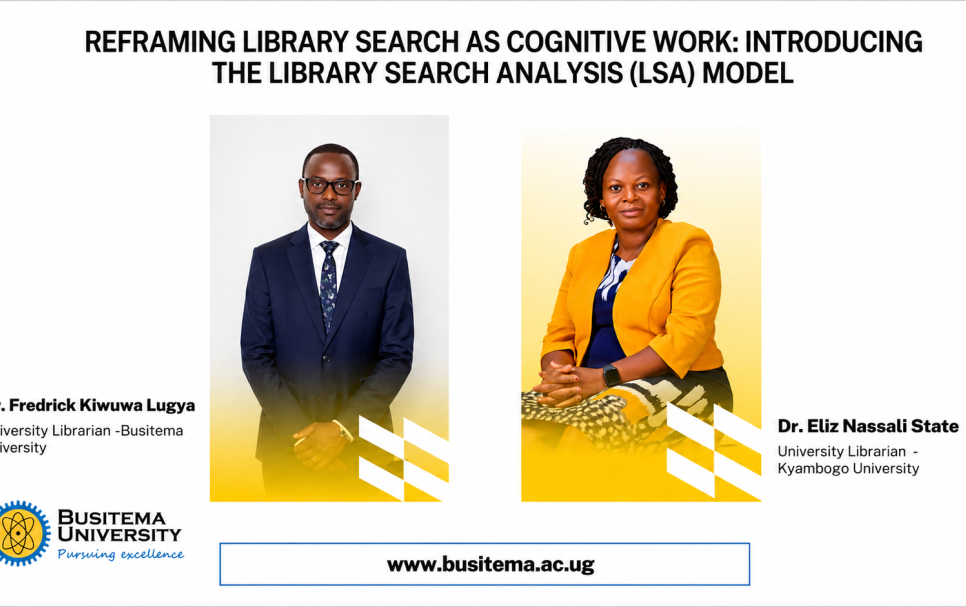
When students and researchers sit down at a library terminal and start typing, what looks like a simple search is rarely simple at all. It involves guessing which words the database will recognise, narrowing down endless results, backtracking when a search goes nowhere, and often starting over with a completely different strategy. A new paper co-authored by Fredrick Kiwuwa Lugya of The Library, Busitema University, and Eliz Nassali State of The Library, Kyambogo University, argues that this everyday struggle deserves to be studied with the same seriousness as the work of a pilot in a cockpit or a nurse in a busy emergency ward.
The paper, "Reframing Library Search as Cognitive Work: Introducing the Library Search Analysis (LSA) Model," was published in February 2026 in Theoretical Issues in Ergonomics Science, a respected international journal that sits at the crossroads of psychology, engineering, and design. In it, the authors propose something that has rarely been attempted in library and information science: borrowing a method built for high-stakes, safety-critical industries and reshaping it to study something as ordinary, and as personal, as looking for information in a library.
The method in question is called Cognitive Work Analysis, or CWA. It was developed decades ago to help engineers understand how people operate within complex systems such as power plants, hospitals, and aircraft, where a wrong decision can carry serious consequences. CWA does not simply record what an operator did. It digs into the constraints around them, including the equipment they had, the rules they had to follow, the information available at that moment, and the reasoning that led to their choice. Lugya and State noticed that library and information science has never really put this framework to full use, even though searching for information is its own kind of complex, adaptive work. People arrive at a search with incomplete knowledge of what they need, adjust their approach as they go, and are shaped by the library's layout, its catalogue design, its rules, and their own experience and confidence. The authors argue that this is not just a technical process. It is cognitive labour, and it deserves a framework rigorous enough to explain not only what searchers do, but why.
Building on this argument, the authors developed the Library Search Analysis Model, a version of CWA reshaped specifically for library settings. Rather than the seven layers used in the original framework, the LSA Model organises the work of searching into four connected parts. The first is the informational ecosystem, meaning the library's resources, systems, and organisational structure that a searcher has to navigate. The second is search task formulation, or how a person turns a vague need into an actual, workable search. The third is strategic reasoning, which covers the decisions and adjustments a searcher makes along the way, including the moments of trial, error, and course correction. The fourth is the actor's cognitive resources, which are the searcher's own knowledge, skills, and mental strategies. The model is meant to be used through methods such as observing searchers in real settings and asking them to describe their thinking as they work. Rather than producing a simple list of complaints or usability glitches, this approach is designed to trace a problem back to its root. The paper offers an example: a student's frustration during a search can often be followed backward, through a failed strategy, through a confusing task, and finally to an outdated or overly technical catalogue interface. That kind of insight points to a specific fix rather than a vague call for "better design."
For institutions like Busitema University, the implications are practical as well as academic. Libraries are constantly weighing decisions about interface design, catalogue systems, information literacy training, and physical layout. The LSA Model gives librarians and system designers a structured way to ask not just whether a system works, but whether it works with the way people actually think and search, rather than against it. The authors describe this shift as moving from systems that are merely usable to systems that are cognitively congruent, meaning they support the natural, sometimes messy way people explore and make sense of information. The paper is candid about the model's limitations too. CWA-style research takes time, careful observation, and resources that many institutions do not have in abundance. Lugya and State acknowledge this directly rather than glossing over it, and they suggest that lighter, faster versions of the model could eventually be developed for smaller projects where a full study is not realistic. They also point to several directions for future research, including testing the model in different types of libraries and applying it beyond library search altogether, to areas such as scholarly research workflows and everyday information seeking online.
What stands out about this paper is where it comes from. Contributions to Cognitive Work Analysis have traditionally come out of aviation, healthcare, and defence research in well-resourced institutions abroad. Here, two Ugandan university librarians are pushing the framework into new territory, arguing that the intellectual work happening quietly at a library search terminal is just as worthy of serious study as the work happening on a factory floor or a hospital ward. For anyone who has ever felt lost while searching a library catalogue, or wondered why some databases seem to work with you rather than against you, this paper offers a rare thing: a genuinely new way to think about a very old and very human activity.
Read the full paper: Lugya, F. K., & State, E. N. (2026). Reframing library search as cognitive work: introducing the Library Search Analysis (LSA) model. Theoretical Issues in Ergonomics Science, 27(4), 374–382. https://doi.org/10.1080/1463922X.2026.2622020
- 225 views